The puppies are working on sit
They are working on sit in a group
They are growing REALLY fast right now. The largest puppy now outweighs the chihuahua, though she is still taller than him with her big ears.
Now off for lunch!
Friday, December 17, 2010
Tuesday, December 14, 2010
Angel
Angel is the second biggest male.
He has big black splotches that match from side to side, just like wings! He is a very bold and dominant puppy. That means he will do better with a person that knows how to set and enforce boundaries.
He is always interested in what people are doing. During leash training this week he would follow along while other puppies were on the leash as if asking to do it again. Angel will be happiest if he has the chance to develop a close bond with his family. Seeing new things is especially important to him as well. He wants a home where he gets to go places with his own special person every day.
Runner
Meet Runner!
She is one of our four females. We called her runner because her legs looked long and she is living up to the name! Runner will want an active household for certain.
She is very inquisitive and always looking for new things. She has great coloring, with evenly placed eye patches and lots of dalmatian spots
We are looking for a home for her with people that want a hiking or workout partner. She will get you out and moving on days when you feel lazy!
Friday, December 10, 2010
Six weeks old- Leash training!
At six weeks the puppies are doing quite well with their toilet training. They have not pooped in their crate for several days. We make sure that they have a chance to go outside right after they eat because we know puppies poop after eating. They get plenty of play time outside
exploring the big semi truck
climbing over tools we left out,
and playing chase.
Now we are on to the next challenge: walking on a leash
Since they are very young and very small it is important to be very gentle with the leash. Our goal is to introduce it in a way that shows them a leash means fun.
We spent several days encouraging them to follow us as we walk around the yard. Every time they go outside or come back in we point them in the right direction, but we never pick them up. They have to make it up the steps on their own.
From this they learn to follow direction and to work towards goals, two things we will be asking them to do on a leash.
The first day we slipped a leash around their neck we only asked for a few steps.
This is the most frightening time for the puppy, so we have to be extremely gentle. We put just one finger worth of pressure on the leash and we wait.
We never drag them forward, this makes them feel helpless. We wait for the puppy to choose to move forward. This is a puzzle for them. They try lots of different solutions to the puzzle: pulling away from the pressure, yelping, grabbing the leash with their mouth, even rolling over. As soon as they try moving toward us we praise them happily. They figured out the puzzle!
The second and third sessions we ask a little more, showing them the true purpose of a leash is to walk together.
In these sessions the some of the puppies would only walk a dozen feet and some went all around our puppy yard. It is up to each puppy how much we do. We make sure that each session shows less fight and more walking. By the fourth day all of them are walking happily around the yard with only short bouts of pulling.
Angel even came up to Judith and asked for another walk when everyone was done, so he got to go all the way to the arena and back!
Wednesday, December 8, 2010
play teaches
The puppies are now in the stage where they are playing any time they are awake. They play with each other.
They play with the big dogs
They play with people
They play with toys
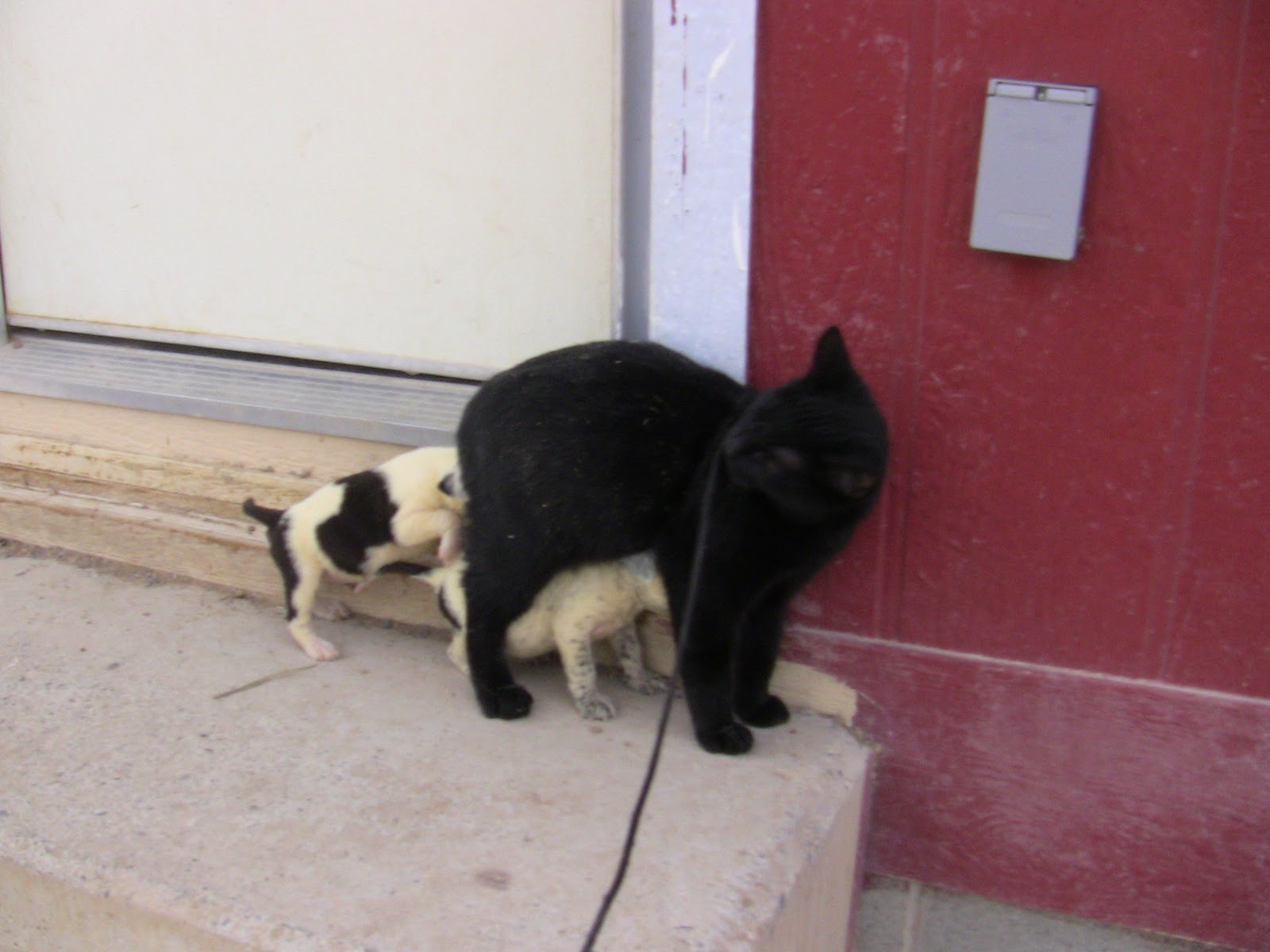
They play with the cat
Play is how they learn to use their bodies well. It is also how they learn that how to treat different categories of animal. From other dogs to cats to different sizes and shapes of people puppies should meet lots of new friends. Then they will grow up to be a well socialized dog who is not scared of new and different people or animals. They develop new pathways in their brain that direct movements they will use their entire lives!
Play is also how they learn bite inhibition- one of the most important skills a pet dog can have. The puppies teach each other how to bite gently by crying out suddenly and stopping their play any time one of them gets too rough. They learn that if you bite hard you don't get to play!
If an adult dog learns is gentle when he bites he is said to have good bite inhibition. This means that if he ever has a disagreement with another dog that turns into a fight it is less likely to turn into a visit to the vet. It also means that if the dog gets so scared he bites a person he will probably not break the skin. It is very important for puppies to do lots of play biting when they are young so they can learn how to do it right!
They play with the big dogs
They play with people
They play with toys
They play with the cat
Play is how they learn to use their bodies well. It is also how they learn that how to treat different categories of animal. From other dogs to cats to different sizes and shapes of people puppies should meet lots of new friends. Then they will grow up to be a well socialized dog who is not scared of new and different people or animals. They develop new pathways in their brain that direct movements they will use their entire lives!
Play is also how they learn bite inhibition- one of the most important skills a pet dog can have. The puppies teach each other how to bite gently by crying out suddenly and stopping their play any time one of them gets too rough. They learn that if you bite hard you don't get to play!
If an adult dog learns is gentle when he bites he is said to have good bite inhibition. This means that if he ever has a disagreement with another dog that turns into a fight it is less likely to turn into a visit to the vet. It also means that if the dog gets so scared he bites a person he will probably not break the skin. It is very important for puppies to do lots of play biting when they are young so they can learn how to do it right!
Friday, December 3, 2010
outdoors
The puppies ventured outside for the first time this morning.
Judith coaxed them off the porch and out into the sun.
They played with the cat and the other dogs
It was a good day!
Judith coaxed them off the porch and out into the sun.
They played with the cat and the other dogs
It was a good day!
Illness
The last few days have been hard ones for the puppies. A few of the puppies had loose stool on Wednesday The largest puppy, Buddha, was lethargic, dehydrated, and not interested in food late Wednesday night.
Judith stayed up all night feeding him small bits of formula every half hour and took him to All Creatures Animal Hospital here in Pahrump first thing in the morning. Their vet checked for Parvo- a disease that is very easy for young dogs to get, and very hard for them to survive. The test came back negative, which is a very good thing. Unfortunately the vet did not have any other ideas on what the problem might be. She was unable to give us any advice on treating the illness or on how to keep it from spreading to the rest of the litter. We were disappointed in the level of assistance that she offered us. On the plus side, our plan to keep Buddha hydrated by feeding him small amounts frequently has worked quite well. By the time he returned from the vet he was bouncing around wanting to play and tonight he is nearly back to his own feisty self!
Several other puppies have been showing similar symptoms since then, but none of them as bad as Buddha's. We are treating them by small frequent feedings and watching carefully for signs of dehydration and diarrhea. The most important thing to do in a situation like this is pay close attention. If you can catch the symptoms of an illness at the very beginning it is much easier to treat. For young puppies staying hydrated is very important, so making sure they get enough fluids is probably the best way to get them back to health!
Judith stayed up all night feeding him small bits of formula every half hour and took him to All Creatures Animal Hospital here in Pahrump first thing in the morning. Their vet checked for Parvo- a disease that is very easy for young dogs to get, and very hard for them to survive. The test came back negative, which is a very good thing. Unfortunately the vet did not have any other ideas on what the problem might be. She was unable to give us any advice on treating the illness or on how to keep it from spreading to the rest of the litter. We were disappointed in the level of assistance that she offered us. On the plus side, our plan to keep Buddha hydrated by feeding him small amounts frequently has worked quite well. By the time he returned from the vet he was bouncing around wanting to play and tonight he is nearly back to his own feisty self!
Several other puppies have been showing similar symptoms since then, but none of them as bad as Buddha's. We are treating them by small frequent feedings and watching carefully for signs of dehydration and diarrhea. The most important thing to do in a situation like this is pay close attention. If you can catch the symptoms of an illness at the very beginning it is much easier to treat. For young puppies staying hydrated is very important, so making sure they get enough fluids is probably the best way to get them back to health!
Subscribe to:
Posts (Atom)